
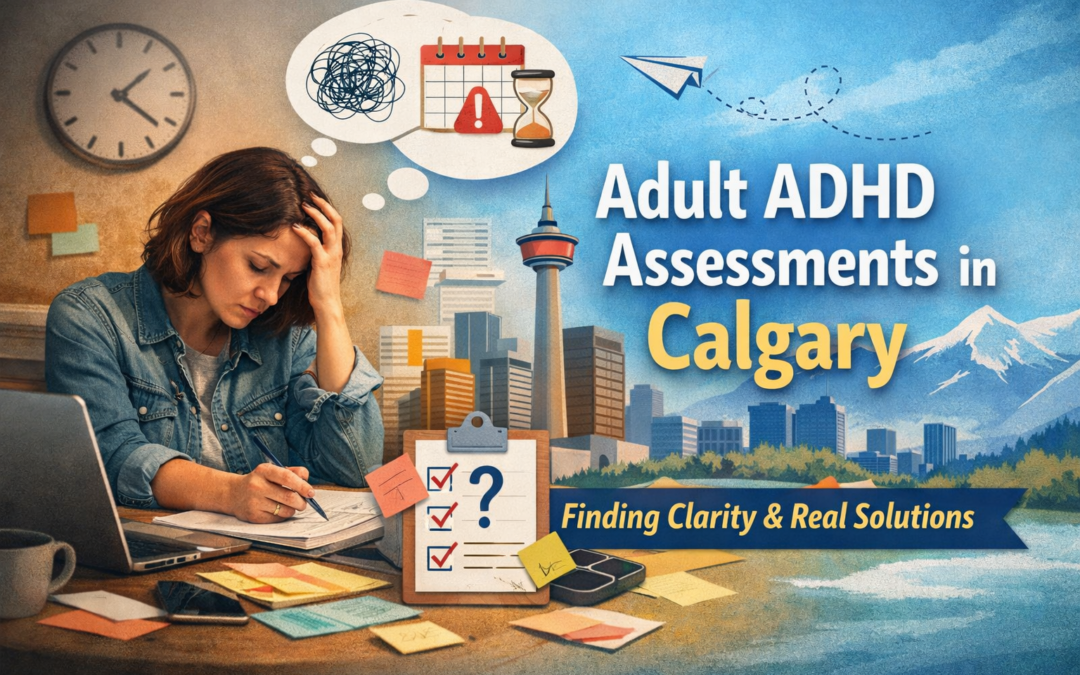
Let’s be honest. If you have spent most of your adult life being told you have potential but just need to apply yourself, that gets old fast. You know you are capable. You feel it. But somewhere between intention and follow-through, things fall apart — and they have been falling apart for as long as you can remember.
At some point, that pattern stops being a bad week and starts being your life.
A lot of people in that position eventually start asking harder questions. Not “what is wrong with me” but “why does this keep happening despite how hard I try.” For many adults in Alberta, that question leads them toward Adult ADHD Assessments in Calgary — and what they find out reshapes how they see themselves entirely.
Nobody Told You ADHD Follows You Into Adulthood
Most of what people know about ADHD comes from watching a restless eight-year-old struggle to sit through class. That image sticks. So when adults start recognizing themselves in descriptions of ADHD, their first reaction is often doubt. Surely that is a kid thing. Surely I would have been caught by now.
But ADHD does not disappear. It adapts. By adulthood, many people have built enough compensating habits and workarounds that the condition stays hidden — from others, and often from themselves. The hyperactivity turns inward. The impulsivity shows up in decisions rather than actions. The distraction becomes a private battle that nobody else can see.
Women are particularly underdiagnosed for this reason. Their symptoms tend to be less disruptive outwardly — more anxiety, more people-pleasing, more quietly drowning while appearing to cope — so they slip through every screening they were ever given.
The people who missed their diagnosis in childhood did not miss it because nothing was wrong. They missed it because the system was not looking for them. That is exactly why Adult ADHD Assessments in Calgary exist for adults specifically — because adult ADHD has its own shape, its own patterns, and it deserves proper clinical attention.
The Patterns That Actually Show Up Day to Day
Adult ADHD does not announce itself loudly. It shows up in the mundane friction of ordinary life.
You read the same paragraph four times and retain nothing. You walk into a room with a clear purpose and stand there blank, the thought gone before you arrived. You agree to a deadline confidently in the moment and then watch helplessly as it passes because you genuinely could not make yourself start.
Conversations are hard to stay inside. Your mind moves on before the other person finishes speaking, not from disinterest but from a brain that cannot hold the thread. Emotions hit harder and faster than they should — frustration, embarrassment, rejection — and the recovery takes longer than you think it ought to.
Time is its own problem. Hours disappear. Urgent things stay undone while something completely unimportant absorbs you completely. The relationship between knowing what needs doing and actually doing it is broken in a way that no amount of motivation seems to fix.
These are not personality traits. They are not evidence of a weak character. They are patterns — consistent, documented, neurological — and they are exactly what clinicians look for when conducting Adult ADHD Assessments in Calgary.
What the Assessment Actually Involves
Walking into an assessment does not mean walking in with proof. You are not expected to arrive diagnosed. You are expected to arrive honestly — and the clinicians handle the rest.
At Compass Clinic, the process begins with a proper clinical interview. Not a checklist read aloud, but a real conversation about your life — how things function at work, how relationships feel, where you struggle most and have struggled longest. Childhood history matters here even though you are an adult, because ADHD leaves traces going back years. Old report cards, early school memories, the things parents or teachers always said about you — all of that is relevant context.
Standardized tools and rating scales are also part of the process, giving the clinician an objective measure alongside everything you describe. Conditions that look similar to ADHD or exist alongside it — anxiety, depression, sleep issues — are screened for as well, because getting the full picture matters more than arriving at a quick answer.
This is why people who go through Adult ADHD Assessments in Calgary at a clinic like Compass leave with something genuinely useful. Not a label handed over in twenty minutes. An honest, thorough understanding of what is actually going on.
What Changes After You Know
The diagnosis itself does something that is hard to describe until you have experienced it. Years of self-criticism suddenly have an explanation underneath them. The story shifts from “I keep failing” to “I have been managing something real without any proper tools.”
That is not a small thing. That reframe is the foundation everything else gets built on.
From there, the path forward is individual. Medication helps some people significantly — not as a crutch, but as a correction that allows the brain to function the way it was always trying to. Therapy designed specifically around ADHD helps others build the practical structure their brain does not generate automatically. Many people benefit from both, combined with coaching and specific strategies for the areas that cause the most daily trouble.
Nobody is pushed toward any particular outcome. The whole point of going through Adult ADHD Assessments in Calgary is to understand your situation specifically — and whatever support comes after should reflect that, not override it.
Choosing the Right Place Matters More Than People Realize
Adult ADHD is genuinely its own clinical territory. It presents differently than childhood ADHD, overlaps with other conditions in complicated ways, and requires a clinician who is not just applying a pediatric framework to a grown adult.
Compass Clinic works specifically with adults. The assessment process reflects that. The environment is not clinical in the cold, transactional sense — it is a place where people feel comfortable being honest about struggles they have kept private for a long time. That comfort is not incidental. It directly affects the quality of what the assessment captures.
If you have ever sat in a doctor’s office and walked away feeling like you were not fully heard, you already understand why the environment matters.
Stop Waiting for It to Sort Itself Out
Here is the thing about adult ADHD — it does not resolve on its own. The patterns do not naturally improve with age or willpower. What changes is the demand placed on you, which tends to grow, and the exhaustion of compensating, which tends to compound.
The adults who describe their assessment as a turning point are not people who had everything figured out before they booked. They are people who were tired enough, honest enough, and curious enough to stop assuming the problem was just them.
If any part of this article has felt uncomfortably familiar — if you recognized yourself in the patterns described here — that recognition is worth following. Adult ADHD Assessments in Calgary at Compass Clinic are available, thorough, and built for exactly this kind of adult. The one who has been quietly struggling and deserves real answers.
Reach out to Compass Clinic directly through their website or by phone to ask about availability and how the intake process works.
Frequently Asked Questions
How long does the assessment take?
It runs across one or two appointments, usually several hours total. That length is deliberate — a thorough evaluation is far more useful than a fast one.
Do I need a referral?
It depends on the clinic’s current process. Call or email Compass Clinic directly to confirm before booking.
What if I was never diagnosed as a child?
Most adults seeking assessment were not. A prior childhood diagnosis is not required — adult presentations are assessed on their own terms.
Will I be prescribed medication straight away?
No. Medication is one option within a broader conversation about what suits you. Nothing is decided without your input.
Can ADHD be mistaken for anxiety?
Regularly. The two conditions share significant overlap and often occur together. A proper assessment sorts through that rather than guessing.
Do I need a diagnosis to access support?
For formal workplace or academic accommodations, yes. Beyond that, many adults simply find that knowing changes how they approach everything — and that alone makes the process worthwhile.
How do I book Adult ADHD Assessments in Calgary at Compass Clinic?
Through their website or by phone. Their team will walk you through the process from there.